 TerminalNexus
In 1998, every Windows 95 machine I touched had the same disease: it got slower the longer you owned it. Programs installed themselves into startup and never asked. The part you could see was the Startup group in the Start menu. The part you couldn't was win.ini's run and load lines plus six registry keys: Run, RunOnce, RunServices and RunServicesOnce under HKEY_LOCAL_MACHINE, and the Run and RunOnce pair again under HKEY_CURRENT_USER. Software vendors knew exactly which of those places users would never look.
This mattered more than it does now, because a machine of that era had maybe 16 or 32MB of RAM, and every program that snuck into startup took its bite. A PC with a year of installed software on it would sit there on boot, disk light flashing, loading things the owner had no idea existed. And Windows 95 shipped with no tool to show you the whole picture, let alone control it.
So I wrote one.
What it did
Startup Manager listed everything that launched with Windows, pulled from all of those places at once, and let you disable any entry individually. Nothing got uninstalled or deleted. You unchecked a program, rebooted, and saw whether the machine got faster or the mystery problem went away. Then you turned things back on one at a time until you found the guilty party. Troubleshooting by elimination, with checkboxes.
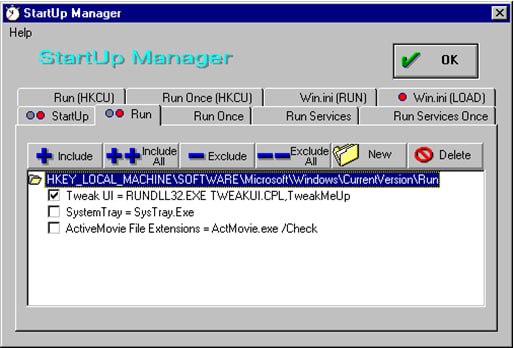
That's the real thing, a capture that still floats around the web in other people's articles about startup programs. Count the tabs: nine of them, one per hiding place. The StartUp group, the four HKEY_LOCAL_MACHINE keys, the HKEY_CURRENT_USER pair, and win.ini's RUN and LOAD lines each got their own view, with Include and Exclude working per entry or on the whole tab at once. The screenshot even catches the era red-handed: Tweak UI, SysTray and ActiveMovie all wedged into the machine-wide Run key, exactly the kind of quiet passengers the app existed to expose.
It had a period-correct bonus feature: disabling the drivers and helper programs for removable drives you weren't using. ZIP drive software was famous for loading at every boot whether a drive was attached or not. If you only plugged the thing in once a month, that was pure waste, and now there was a checkbox for it.
The whole app was one small download, 684KB, written in C++ with Visual C++ 5.0 and MFC 4.0 against the Windows 95 API. I wrote the Windows help system for it too, because in 1998 you did not ship an app without a proper help file.
Distribution, 1998 style
There was no app store. You uploaded your program to download portals and waited. Startup Manager was free, and it traveled: PC World Online listed it under System Resources Tune-Up, where their counter logged 77,179 downloads, and across all the download sites of the era it added up to somewhere around 400,000. Then the May 1998 issue of PC World, the paper magazine, featured it.
I can quote the PC World numbers exactly because I saved a copy of that download page, and it has survived every computer, browser and note system migration since. Some files you just don't delete:)
That feature did not fall out of the sky either. I had written to Scott Dunn, the Windows Tips columnist, the year before, and his reply from November 1997 is still in my mail: "I finally did download StartUp Manager (2.0) from zdnet and it looks great. I plan to feature it in the May 1998 installment of my column." He kept his word to the month.
The print feature itself is easy to check today. The whole PC World archive is scanned and sitting at vintageapple.org, and there it is in the May 1998 issue, page 290, a Windows Toolbox sidebar in the Windows Tips column:
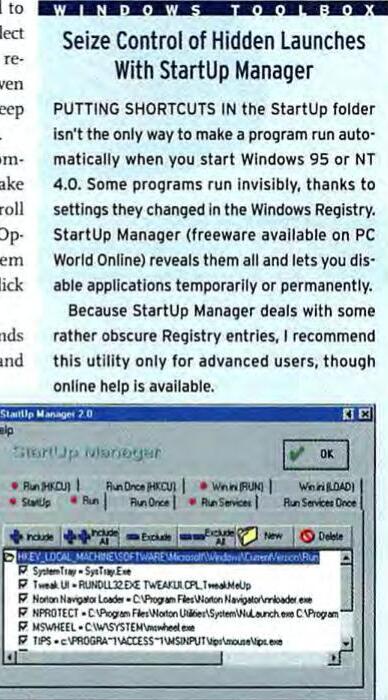
"Seize Control of Hidden Launches With StartUp Manager." They even reprinted a screenshot of version 2.0, and noted it handled NT 4.0 as well as Windows 95. My favorite line is the caution at the end, that because StartUp Manager deals with "some rather obscure Registry entries," the columnist recommends it "only for advanced users." In 1998 that sentence was a badge of honor.
That sidebar hit harder than the download counter ever did. PC World and the C++ journals were my treasure back then; I read every issue that came out. Getting a sidebar in one of them meant the magazine I learned from was now telling other people to go get my program.
And the American edition turned out to be one branch of the family. The mail told me where else the app was traveling, because every reader who wrote in got the same question back: how did you come across it? PC WORLD Italy was putting it on their cover CDs, all of them, a reader in Italy reported, "as very important program that everyone must have." Germany's PC-WELT, one of the highest-circulation computer magazines there, shipped it on the August 1998 cover CD. New Zealand's PC World wrote it up. Someone at a university in Shiraz, Iran emailed asking how to get a copy after seeing a PC World mention. I never sent the app to any of those places. It went on its own.
Whether everyone asked first is another story. My license was explicit that CD distribution as part of anything sold required my written permission. Macmillan read it and faxed the agreement. How many of the magazines pressing my app onto their cover discs did? I'll let you count the letters:)
By early 2000, ZDNet sent a letter of their own: StartUp Manager was among the most popular 5% of all downloads on the site, which qualified it for free hosting on their download servers. For a 684KB freeware utility with no website of its own, that was the entire distribution department reporting in.
The book, and the CD in the back
Then there was the book. In June 1998, three weeks before Windows 98 itself reached stores, a software specialist at Macmillan Computer Publishing emailed me: they were putting together Using the Windows 98 Registry and wanted permission to include StartUp Manager on the book's companion CD. Standard distribution agreement, sign and fax back, and the app made it aboard.
The book didn't stop at the CD. Pages 322 and 323 give the app a full entry in the registry-tools roundup: Cost: Freeware. Vendor: Daniel Hofman. And the paid tool listed right above mine gets sent off with a line I could not have written better myself: "You must be the judge as to whether this simple program is worth the cost, considering that the StartUp Manager, described next, is free."
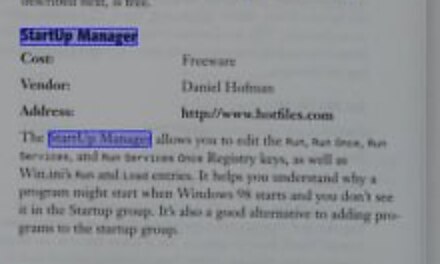
So every copy of that book left the store with StartUp Manager riding along on the disc in the back. To a self-taught programmer, the Macmillan computer books were the authority on how Windows actually worked. Ending up inside one, next to the registry keys I was poking at, was about the highest recognition 1998 had to offer.
The mail that kept coming
Support in those days was email, straight to the author. Mail about StartUp Manager kept arriving from 1998 into 2002: Germany, Italy, France, the Netherlands, the UK, South Africa, Israel, Singapore, Australia, New Zealand, Iran, the US. I kept all of it, and reading it back is like opening a time capsule. A few of them, exactly as they arrived, spelling and all:
"I recieved your program with an Cd from a german computer newspaper called PC-Welt and must say, that this is exctly what I was looking for (for years). It runs stable under W98 and works fine." (Holger, southern Germany)
"Greetings from Singapore :) I would like to thank you for creating such a marvellous program as StartUp Manager 2.0. Finally, I can get my startup programs in order" (Glenn, Singapore)
"Within 1 min of using it I found what I was looking for and removed them from the run ounce sequence. Now Win95 startsup faster and desktop looks a lot better. The best utility progs are the small and simple to use like StartUp Manager." (Allan, New Zealand)
"Great program - it saves me tons of time!" (Clinton, South Africa)
"First of all, I'd like to say it's GREAT having someone still writing USEFUL shareware, and we need more people doing this around! Second, I'm a computer manufacturer and I'd just like to ask permission to install this program on some of the systems we build." (Dave, a PC builder)
A user in Germany wrote "I delight in your Start-Up Manager, which helps me every day." One in France used it to switch everything off at boot so his machine had enough resources for video capture, exactly the job it was built for. Another correctly reported that touching the HKCU keys froze the app on NT 4.0, then offered to port it himself and guessed it was written in Delphi. It wasn't:) And plenty of messages simply asked where to download it, because a free app with no website of its own lived wherever the portals put it.
Support requests for a freeware utility, still coming in three years after release, answered one by one over dial-up era email. That was the deal, and I loved it.
The OS caught up, eventually
The funny part in hindsight is the timeline. A few months after my app was already out, Windows 98 shipped msconfig, the first built-in peek at startup entries. This is what it looked like:
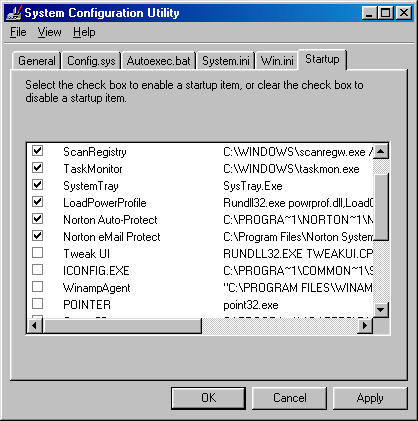
Checkbox per entry. Uncheck to disable, reboot to test, recheck to restore. Troubleshooting by elimination, with checkboxes. If that description sounds familiar, it's because you already read it a few sections up. Their version flattened everything into one merged list, where mine gave each hiding place its own tab so you could see where an entry actually lived, but the model is the same one. And the dates line up in an entertaining way: my v1.0 was on the download portals in 1997, v2.0 was on PC World Online by March 1998 and in the printed magazine in May, and Windows 98, msconfig aboard, reached stores on June 25, 1998. I'm not saying anyone in Redmond had a 684KB freeware download on their machine that spring. I'm saying the timeline doesn't rule it out, and mine had more tabs:) (Screenshot from NetSquirrel's classic msconfig guide.)
A real Startup tab in Task Manager took until 2012. Today it's all right there in Settings, one toggle per app, and nobody under thirty can imagine it otherwise.
I don't mind. A one-person freeware beating the OS to a feature by fourteen years is a fine story to have in the drawer. And the instinct behind it never left: notice the thing quietly eating your machine, and give the user a checkbox for it. I've been building variations of that ever since.
Comments